

Healing & Regeneration, Peptides, TB-500
TB-500 Research Applications: Actin Regulation and Cell Migration
Summarize the article with:
 ChatGPT
 Claude
 Perplexity
 Google AI
Aug
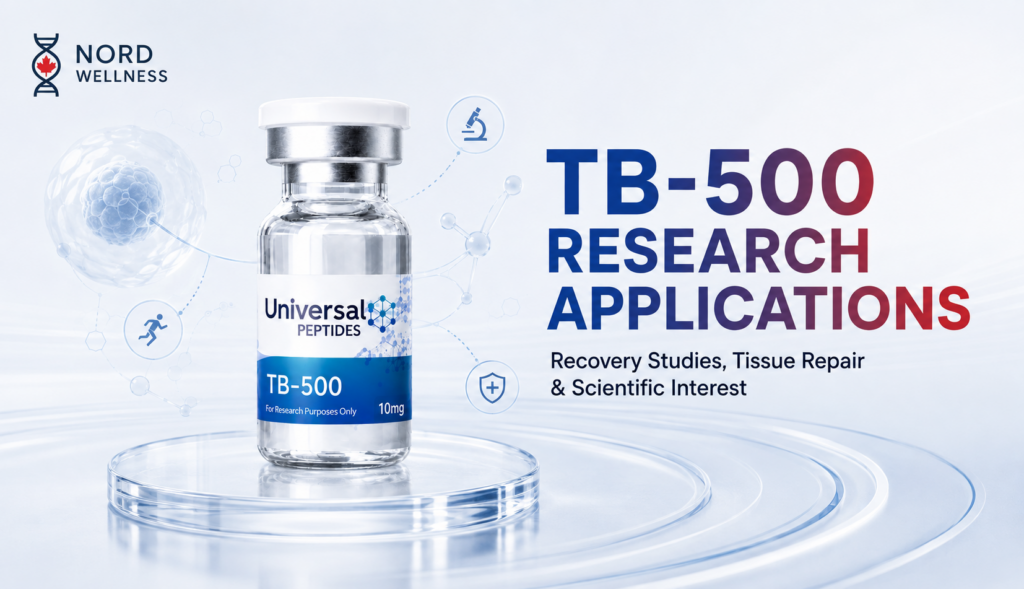
TB-500 research applications are commonly discussed in relation to actin regulation, cellular migration, cytoskeletal organization, and extracellular-matrix biology. These experimental subjects are linked to the peptide association with thymosin beta-4.
A clear distinction between TB-500 and full-length thymosin beta-4 is necessary when reviewing the literature. Mechanistic evidence for one should not be treated as interchangeable with direct evidence for the other.
Principal Laboratory Research Areas
- Actin-related biology: examining cytoskeletal organization and cell structure.
- Cell migration: measuring movement and adhesion under controlled conditions.
- Vascular-cell models: investigating endothelial behavior and angiogenesis-associated markers.
- Matrix biology: examining cellular interactions with structural proteins.
These categories describe research questions, not established applications outside experimental settings. Each depends on a specific model, comparator, and measured endpoint.
Actin Regulation and Cellular Organization
Actin participates in maintaining cell structure and coordinating movement. Thymosin beta-4 has been studied for actin-binding activity, which explains why actin-associated measurements appear in discussions of TB-500 research.
Researchers can use cytoskeletal assays to examine organization, adhesion, and cellular responses to peptide exposure. Interpretation requires direct evidence for the compound being tested rather than inference from a related peptide.
Cell Migration and Matrix Interactions
Migration assays provide information about how cells move and interact with their environment. Relevant measurements may include cell position, adhesion markers, F-actin arrangement, and matrix-associated signaling.
No single assay captures the full complexity of cell behavior. Concordance across controlled experiments and independent models provides a stronger basis for mechanistic interpretation than an isolated result.
Vascular and Endothelial Models
Endothelial models are used to investigate cell migration, organization, and vascular-associated signaling. Findings involving angiogenesis-related markers should be reported as experimental measurements rather than functional outcomes in other biological systems.
Evidence Limitations
Available TB-500-related evidence is predominantly laboratory-based or preclinical. Differences in peptide identity, model selection, and experimental methods limit broad generalizations.
These observations do not establish safety, efficacy, or clinical outcomes in humans.
For research use only. Not for human consumption. Not intended for human or veterinary use.


This was a really useful overview of the research applications surrounding TB-500. I liked how the article connected cell migration, angiogenesis, and tissue repair to the broader mechanisms being investigated with thymosin-related peptides. The research-focused approach also makes it easier to distinguish areas of scientific interest from established clinical evidence.
Great article overall. The discussion of vascular research and cellular migration was particularly interesting, especially given the existing literature on thymosin beta-4 and angiogenesis. I’d be curious to see more detail on which findings can be directly attributed to TB-500 itself versus research involving thymosin beta-4, since that distinction seems important when evaluating the evidence.
Really enjoyed reading this article. The overview of tissue repair, vascular signalling, and cellular behaviour gives a good picture of why TB-500 continues to attract research interest. One topic I’d love to see explored further is how TB-500 compares with BPC-157 in experimental models, particularly in terms of their proposed mechanisms and the quality of the available evidence.